
This is a site for users in remote areas wanting to update their knowledge and skills.
My basic philosophy in community–based research (a.k.a., grass–roots science) has always been—
- that technical skills and expertise are to be developed within the communities in order for this knowledge base to be retained after a contract or grant period ends.
I believe that when communities ask their own questions, have their own data, and their own collation, analysis, and interpretation of others’ data they will
- understand the disease and health trends of their communities;
- be able to predict the health trends and prepare for appropriate action for the communities;
- portray the total health and environment program requirements of the tribal communities to other communities, organizations, and Congress;
- allocate scarce resources for their own protection in the most productive manner;
- participate fully in the development of health information systems, useful to other rural communities, especially in areas of the release of hazardous materials and environmental threat;
- enable tribal leadership to effectively communicate environmental and health concerns to their respective communities;
- enable the communities to choose wisely among various outside offers of technical and scientific help; to control the quality of the data, research, analysis, and products from outside contractors, consultants, and agencies; and to oversee and coordinate the efforts of BIA and IHS executed on behalf of tribal communities.
~~~~~~~~~~~~~~~~~~~~~~~~~~~~~~~~~~~~~~~~~~~~
There doesn’t seem to be any other way to show my profile, so here it is on this page.
My special areas—
* Capacity–building among tribal governments and rural communities in environment, health, information technology, natural resources, and science * Community–based research, economic development, & management * Organizational culture of nuclear weapons laboratories * Complex systems * Cultural resources & museums * Strategic planning, public involvement * Teaching, including community outreach and public interpretation
My previous projects include—
- Head, environment, safety, & health programs, Eight Northern Indian Pueblos Council, New Mexico tribes (water quality standards, solid waste, emergency response, hazards of traditional arts, community-based research center)
- Statewide coordinator, public involvement, New Mexico Highway & Transportation
- Regional coordinator, resource conservation & development, Lower Kuskokwim watershed, remote western Alaska
- Health careers advisor, Yukon Kuskokwim Health Corp.
- Statewide specialist for rural solid waste, Alaska Dept. of Environmental Conservation, Villages north of Alaska Range
- Faculty, Anthropology & Maori Studies, University of Auckland, Aotearoa / New Zealand. Impact of diet, disease, and social change on indigenous and immigrant populations. Associate Faculty in Environmental Studies Graduate Programme
- Manager, regional non–profit bookstore and Native crafts, Moravian Book Store, western Alaska
- Faculty, applied business & office technology, Kuskokwim Campus, rural Alaska community college
- Museums, cultural resources, New England USA, Southwest USA, Midwest USA, Fiji
- Girl Scout nature director and unit leader
- Post–doctoral fellowship, long–term impacts of diet, disease, and cultural change (isotope biogeochemistry & health), Los Alamos National Laboratory
Credentials by themselves are not the best judge of reliability and validity, but they can be an important tool.
- Ph.D., human biology and cultural adaptation, (environmental biogeochemistry and human ecology) University of Massachusetts, Amherst
- Dip., Human Biology, University of Oxford (Wolfson College), equivalent to MS public health
- B.A. cum laude, anthropology, natural sciences, Spanish, Beloit College (USA)
I’m a long-time member of Sigma Xi, the scientific research society (evidently the only member in remote Alaska)
previously
professional member of American Indian Science & Engineering Society (AISES)
founding board member, Australasian Society for Human Biology
American Association for the Advancement of Science (AAAS one of three of us in remote Alaska)
other stuff here—
http://13C4.wordpress.com
~~~~~~~~~~~~~~~~~~~~~~~~~~~~~~~~~~~~~~~~~~~~
To ask questions about this site, please use the comments for individual posts or Doctor is in
 or this newfangled contact form (which is not made public)
~~~~~~~~~~~~~~~~~~~~~~~~~~~~~~~~~~~~~~~~~~~~
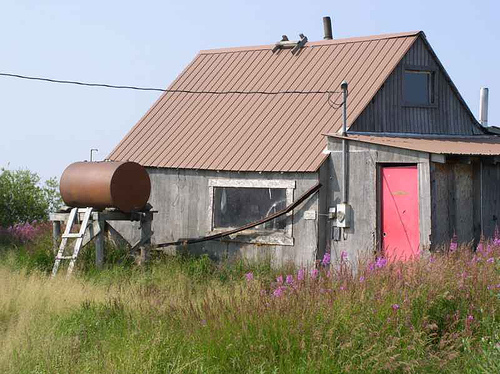
There was a wonderful series of prints developed by an artist named Archie Barnes on Bethel, about 1986 1983. Mrs. Evelyn Tikiun’s (1927-2007) house across the Slough was one of the prints. Here is the house today.
Here is a portion of the print, 24 years ago, 1983 Dwelling on the Tundra

revised 2007-07-11 Archie Barnes currently operates Phoenix Row, an arts complex in Maine, http://www.phoenixrow.com/ as described here, Phoenix Row — from ashes to art By James D’Ambrosio
Site Search Tags: Archie+Barnes, community+based+research, CBPR, Bumsted, Alaska, grassroots+science, New Mexico
Technorati Tags: Archie+Barnes, community+based+research, CBPR, Bumsted, Alaska, grassroots+science, New Mexico,
 Grassroots Science
hello, pam,
began a message, then wanted to check something on your site and my comment was lost. mainly want to thank you for coming by, honoring your knitting grandmother.
when i had psychotherapy practice in baltimore–a very wet city–i’d show clients a map of legal and illegal drinking sites in 1886. there were 9,000 places selling liquor from the battery to 114th street. i wanted those who had relatives who were/had been alcoholics that there is a very long history of substance abuse in america, it was not new, nothing to be ashamed of, simply understand.
yours, naomi
Site Search Tags: knitting, maps, alcohol
LikeLike
Thanks, Naomi, for adding to the mapping resources (c.f., Where is… underage drinking) I hadn’t thought about using maps in that way; what a good idea.
LikeLike
2007March16
China promotes ‘grassroots’ science in the provinces
http://www.scidev.net/News/index.cfm?fuseaction=readNews&itemid=3488&language=1
China’s central government has signed deals with the country’s provincial governments to support regional science.
2005May31
‘Don’t ignore grassroots scientists’, China urged
http://www.scidev.net/News/index.cfm?fuseaction=readNews&itemid=2113&language=1
Chinese researchers have urged their government not to ignore the role that ‘grassroots scientists’ can play in their country’s development.
LikeLike
hey- I think that you are the person who left a comment on my site… anyway, I love the idea about collecting insects and using them as an indicator of environmental change… perhaps when bugs start showing up again… right now we wouldn’t catch anything. It’s something to think about for next year and for science fair projects.
Thanks.
-thomas
LikeLike
Yes, indeedy. Bugs will be out before school so maybe some might want to practice this year, but to think about for next year would be great.
http://www.xanga.com/wcbpolish/647413875/my-welcome-back.html
LikeLike
Where can I find the lysol in the brown bottle? none of the stores in the o6112 area seem to carry it. please help
LikeLike
@ mary ball:
I don’t know. You might try an old fashioned hardware store. If you have access to a large supermarket they may be able to order some for you. You could also try calling the company– 1-800-228-4722 in the USA to see where their re-sellers might be. If nothing else, you can try Lehman’s catalog (lehmans.com) or the Vermont Country Store.
LikeLike
you aren’t the only “remote alaskan” to belong to such organizations as AAAS or AISES or other professional organizations with a phd in anthropology. I read your information with a grain of salt. Do know the disaster plan for the tsunami-like crush of H5N1 when it hits?
LikeLike
@ tundraboy:
There should be several AISES students in the rural areas. The UAF chapter has been very strong and some high schools have chapters. I used to be a professional member.
According to the AAAS directory, there are about 3 people outside of Fairbanks-Juneau-Anchorage-Kodiak (none in the Unorganized Borough).
According to the Sigma Xi directory, there is just one in rural Alaska, me.
I would like to know of more, so we can put our heads together, so to speak. 2008-04-24 Here is a PhD researcher in birds (auklets) Researcher in the Unorganized Borough
As far as disaster plans, unfortunately the planning in most Alaska communities is slim to none. The state plan still relies on getting Tamiflu out, but only to limited numbers, assuming it is effective, and assuming there is any, and assuming planes will be allowed to fly.
LikeLike
Hi, I am having problems with a large amount of phlem in my throat,and usually it is the worst in the am hours of the waking morning.What is wrong and what remedies can I try to stop this mess?
LikeLike
@ Sandy:
This could be anything from merely annoying to serious. But I would suggest first that you look to see if improving your bedroom humidity or your pillow setup will work. I sometimes have trouble with allergies so have to try sleeping with my head elevated slightly. I also use NoseBetter or similar saline nose sprays (just the salt water, not the decongestant types) to moisturize and wash my nose and sinuses. This is a good trick for preventing the spread of germs, too, even back to myself.
You might write down when you have the worse problems (seasonal?) and what you may have eaten or drunk just before bedtime. A humidifier in winter might help or keeping the windows closed in spring. Or, forgoing the nightcap (alcohol dries out tissues) and some people have trouble with milk causing a film in the mouth. Herbal teas may also affect tissues (herbs are chemicals, too, and many are very powerful). However, a plain non-caffeine tea, such as peppermint or even lemon slice in water, might keep you hydrated.
If simple steps don’t work, then check with your doctor or dentist. Bring your notes with you.
LikeLike
good site…. can you add me to your distribution list? BTW, how do you organize your distribution list.
thanks,
carl
LikeLike
Hi, Carl. Thank you for your feedback.
Distribution is done by several means–
RSS subscription– those orange squares contain the links to subscribe to the blog or to the Tumblr or GoogleNews etc.
my Tumblr posts, More Grassroots Science (on Tumblr) – http://hlthenvt.tumblr.com/
FYI Sci Lib Mus Newsclips for the Unorganized Reader – http://www.google.com/reader/public/atom/user%2F12028416974717231708%2Fstate%2Fcom.google%2Fbroadcast
Email for each post or for all new posts through the blog (on the sidebar, Email Subscription Click to subscribe to this blog and receive notifications of new posts by email.
There’s FriendFeed which you can subscribe to and pick up nearly every venue, http://friendfeed.com/unorganizedborough
There’s also Facebook which I think gets what Friendfeed collects– http://www.facebook.com/bumsted
For rural teachers, I have an occasional emailing. Let me know and I can add you to that. The email list allows longer pieces and not just links.
Unfortunately, I am not as regular on WordPress as I was before needing to come into Anchorage for paid work. I have taken up with the quicker formats, so FriendFeed might be useful to you.
With all of Facebook faults, I can get links from the FriendFeed grouper as well the Google News Reader to show up automatically. It’s almost impossible to get Facebook to feed into the WordPress site, at least I haven’t found a good way, without getting into a loop between the venues.
PS– I’ve been using FeedDemon as my newsfeed reader because i can share on Google Reader. However, my favorite rss reader is Great Expectations because it will annotate and save locally what I read. However, it doesn’t like a large number of things to read and track and kept crashing.
LikeLike